 Taxtirement
Retirement tax questions · 2026 figures
Will Medicare surcharges (IRMAA) hit us?
With higher income, Medicare adds a surcharge, called IRMAA, to your Part B and Part D premiums. It's set by your income from two years earlier and goes up in steps, so a Roth conversion, a home sale or a large withdrawal can raise premiums two years later. Here are the 2026 brackets and how to see the surcharge coming.
In short
- In 2026, the surcharge starts at income above $109,000 for a single person and $218,000 for a married couple filing jointly.
- 2026 premiums are based on 2024 income: what you do this year sets your premiums two years from now.
- The tiers are cliffs. One dollar over a line costs the whole step for the year, for each person on Medicare.
- If income dropped after retiring, the death of a spouse or another life-changing event, you can ask Social Security to use the more recent year.
The 2026 IRMAA brackets
Each person on Medicare pays the standard Part B premium of $202.90 a month in 2026, plus the amounts below if income was above the first line. The income is modified adjusted gross income (adjusted gross income plus tax-free bond interest) from your 2024 tax return.
| Single: income 2024 | Married filing jointly: income 2024 | Part B, per month | Part D add-on, per month |
|---|---|---|---|
| $109,000 or less | $218,000 or less | $202.90 | none |
| Over $109,000 to $137,000 | Over $218,000 to $274,000 | $284.10 | +$14.50 |
| Over $137,000 to $171,000 | Over $274,000 to $342,000 | $405.80 | +$37.50 |
| Over $171,000 to $205,000 | Over $342,000 to $410,000 | $527.50 | +$60.40 |
| Over $205,000, under $500,000 | Over $410,000, under $750,000 | $649.20 | +$83.30 |
| $500,000 or more | $750,000 or more | $689.90 | +$91.00 |
The Part D add-on is paid on top of your drug plan's own premium, whichever plan you have. Married people who file separately and lived with their spouse during the year have their own, steeper tiers.
Why it's hard to see coming
- The two-year lag. The bill arrives long after the income. A conversion in December shows up in premiums two Januarys later, when it's too late to change.
- Cliffs, not slopes. Tax brackets charge more only on the income above the line. These tiers charge the whole step as soon as you cross it.
- Income you don't think of as income. Tax-free municipal bond interest counts. So do Roth conversions, capital gains from rebalancing or selling a home, and the taxable part of Social Security.
- The survivor's lines are half as high. After one spouse dies, the single lines apply, often to most of the same income (see the widow's penalty).
What crossing a line costs
Take the first line for a couple, $218,000 of 2024 income. One dollar over it moves each of them from the standard $202.90 Part B premium to $284.10, and adds $14.50 to Part D:
| Extra per person, per month | $95.70 |
|---|---|
| Extra per person, per year | $1,148.40 |
| Extra for a couple both on Medicare, per year | $2,296.80 |
At the top tier the extra is about $6,936 a year per person. Whether a conversion that crosses a line is still worth it depends on what it saves later, which is a comparison across many years.
When income drops: the appeal
If your income fell because of a life-changing event, such as stopping work, the death of a spouse, divorce or the loss of a pension, you can ask Social Security to use the more recent, lower year with Form SSA-44. Many people in their first years of retirement are charged on their last working years' pay and don't know they can ask.
Medicare usually announces the next year's premiums and tiers in the fall. This page shows the 2026 figures and is updated when the next year's are published.
What Taxtirement shows
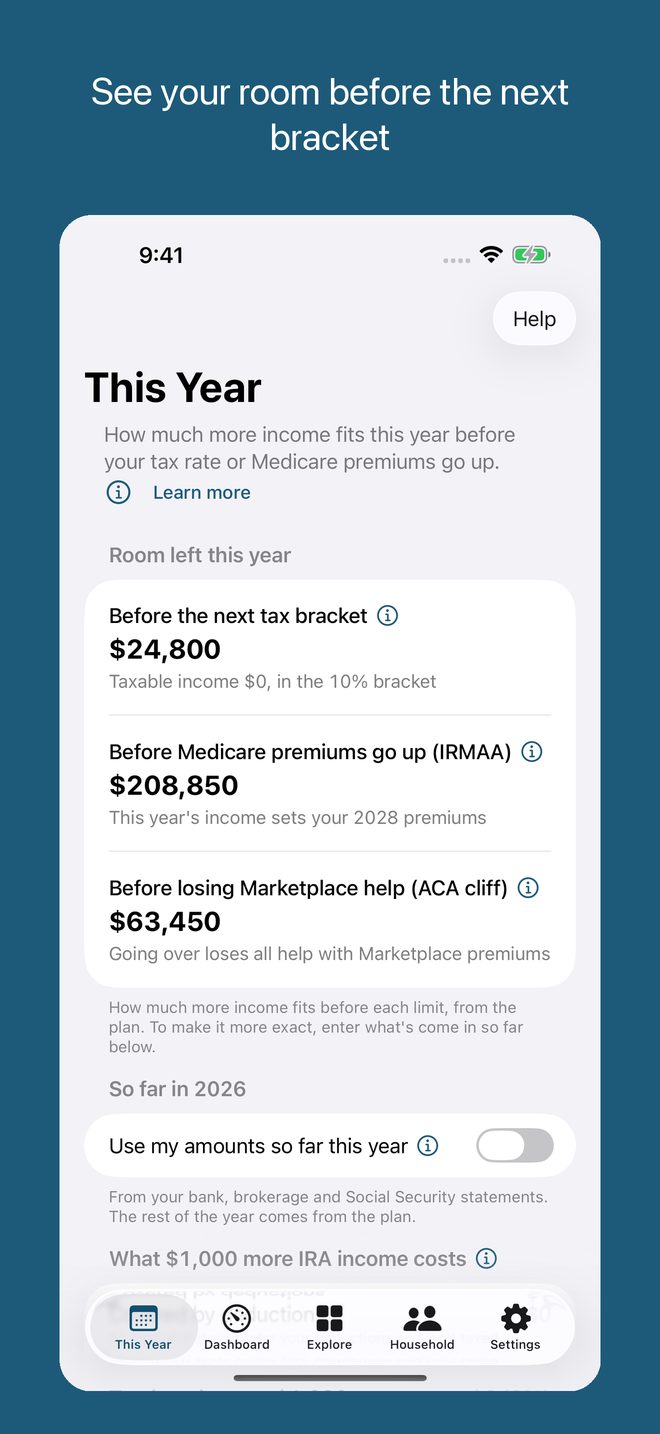
- Room until the next Medicare tier this year, for the premiums you'll pay two years from now, on the This Year screen and a home-screen widget.
- Surcharges in every year of the plan, including the survivor years, added into lifetime costs.
- Roth conversion scenarios that stay under a tier you choose (the standard premium, or the first or second tier), next to scenarios that don't.
- What the next thousand dollars costs, with everything it touches: the bracket, Social Security, deductions and Medicare premiums.
- An appeal setting that assumes you ask Social Security to use your lower income after retiring or after a spouse's death.
References
The rules and figures on this page come from these official sources; the household in the example is made up. The app's calculations are also checked against them; see How we check our numbers.
Laws
- 42 U.S.C. § 1395r: Medicare Part B premiums, including the income-related amounts (uscode.house.gov)Used for: how higher incomes raise the Part B premium
- 42 U.S.C. § 1395w-113: Medicare Part D premiums, including the income-related amounts (uscode.house.gov)Used for: the Part D income-related add-on
Regulations and official guidance
- 20 CFR 418.1135: Which year's income sets the Medicare income-related amount (ecfr.gov)Used for: the two-year lookback (2026 premiums use 2024 income)
- 20 CFR 418.1205: What is a major life-changing event? (ecfr.gov)Used for: the events that let you ask for a more recent year's income
- Premiums: Rules for higher-income beneficiaries (ssa.gov)Used for: how Social Security sets the surcharge and the income it usesSocial Security's site refuses automated link checks; this address was confirmed in a browser.
Forms, instructions and publications
- Form SSA-44: Medicare Income-Related Monthly Adjustment Amount, Life-Changing Event (ssa.gov)Used for: asking for a lower surcharge after income dropsSocial Security's site refuses automated link checks; this address was confirmed in a browser.
Agency data
- 2026 Medicare Parts A & B Premiums and Deductibles; 2026 Part D income-related amounts (cms.gov)Used for: the 2026 Part B premium and every IRMAA tier for Parts B and D
See it with your own numbers. Taxtirement works out every year of retirement for your household, federal and state, and puts the scenarios side by side so you can compare them. Coming November 2026 for iPhone, iPad and Mac.
More retirement tax questions
- Should we convert to a Roth, and how much?
- When should each of us start Social Security?
- What happens to our taxes when one of us dies?
- Before Medicare, how do we keep Marketplace (ACA) help?
- Should we give to charity from the IRA (QCDs)?
This page explains the 2026 rules as Taxtirement applies them, for education and planning. The example is a simplified household (federal income tax only, unless it says otherwise); your own figures will differ. It isn't investment, tax or legal advice. Rules change; check the official instructions, or a tax professional, before acting. Spotted something wrong? Tell us.