 Taxtirement
Retirement tax questions · 2026 figures
What happens to our taxes when one of us dies?
After a spouse dies, the survivor usually files as single, with brackets about half as wide and lower limits everywhere, often on most of the same income. Taxes and Medicare premiums can go up even though the household is smaller. Planners call it the widow's penalty. It falls on widowers too, and it's one of the main reasons couples look at Roth conversions while both are alive.
In short
- In the year of the death the survivor can usually still file jointly. From the next year, unless they have a dependent, they usually file as single.
- One Social Security benefit stops (the survivor keeps the larger one), but IRA withdrawals and many pensions continue.
- Single-filer brackets, deductions and Medicare surcharge lines are about half of a couple's, so more of the income is taxed at higher rates.
- In the example below, income falls by $15,600 a year and federal tax rises by $3,709.
Why it's easy to miss
Couples plan as a couple. The years one of you may live alone are easy to leave out of the plan, and there can be many of them. The income doesn't shrink as much as the limits do:
- Social Security: the smaller of the two benefits stops; the larger one continues.
- IRAs: a surviving spouse can treat the IRA as their own. The balance is the same, so required withdrawals are about the same, now on a single return.
- Pensions: a joint-and-survivor pension continues, in full or in part.
What changes on a single return (2026)
| Limit | Married filing jointly | Single |
|---|---|---|
| Top of the 12% bracket (taxable income) | $100,800 | $50,400 |
| Standard deduction | $32,200, plus $1,650 for each spouse 65 or older | $16,100, plus $2,050 at 65 or older |
| Senior deduction starts to shrink above | $150,000 | $75,000 |
| Social Security starts to be taxed above | $32,000 | $25,000 |
| Up to 85% of Social Security taxed above | $44,000 | $34,000 |
| First Medicare surcharge (IRMAA) above | $218,000 | $109,000 |
| Investment income tax above | $250,000 | $200,000 |
The Social Security and investment-income lines are written into the law and have never been raised for inflation, so more retirees cross them every year.
An example with 2026 figures
A married couple, both over 65. They take $70,000 a year from IRAs, and their Social Security benefits are $2,400 and $1,300 a month. One of them dies. The next year, the survivor takes the same $70,000 from the IRAs (now their own) and keeps the larger benefit.
| Federal income tax | Together | Survivor alone |
|---|---|---|
| IRA withdrawals | $70,000 | $70,000 |
| Social Security for the year | $44,400 | $28,800 |
| Household income | $114,400 | $98,800 |
| Taxable part of Social Security | $37,740 | $24,480 |
| Adjusted gross income | $107,740 | $94,480 |
| Deductions, including the senior deduction | $47,500 | $22,981 |
| Taxable income | $60,240 | $71,499 |
| Bracket | 12% | 22% |
| Federal income tax | $6,733 | $10,442 |
The household's income falls by $15,600, and its federal income tax rises by $3,709. The survivor's senior deduction also starts to shrink, because their income is above the single line. And their income is now only $14,520 below the first single Medicare surcharge line, which is half the couple's; a larger IRA withdrawal or a capital gain of more than that would raise their premiums two years later.
What couples can look at while both are alive
- Roth conversions in the joint-filing years, when the brackets are wider, so less sits in IRAs for the single years. See Roth conversions.
- When the larger Social Security benefit starts, since it becomes the survivor's benefit. See Social Security start ages.
- Pension survivor options: how much of a pension continues to the survivor.
- The Medicare appeal: after a spouse's death, the survivor can ask Social Security to base the surcharge on the new, lower income (Form SSA-44). See Medicare surcharges.
What Taxtirement shows
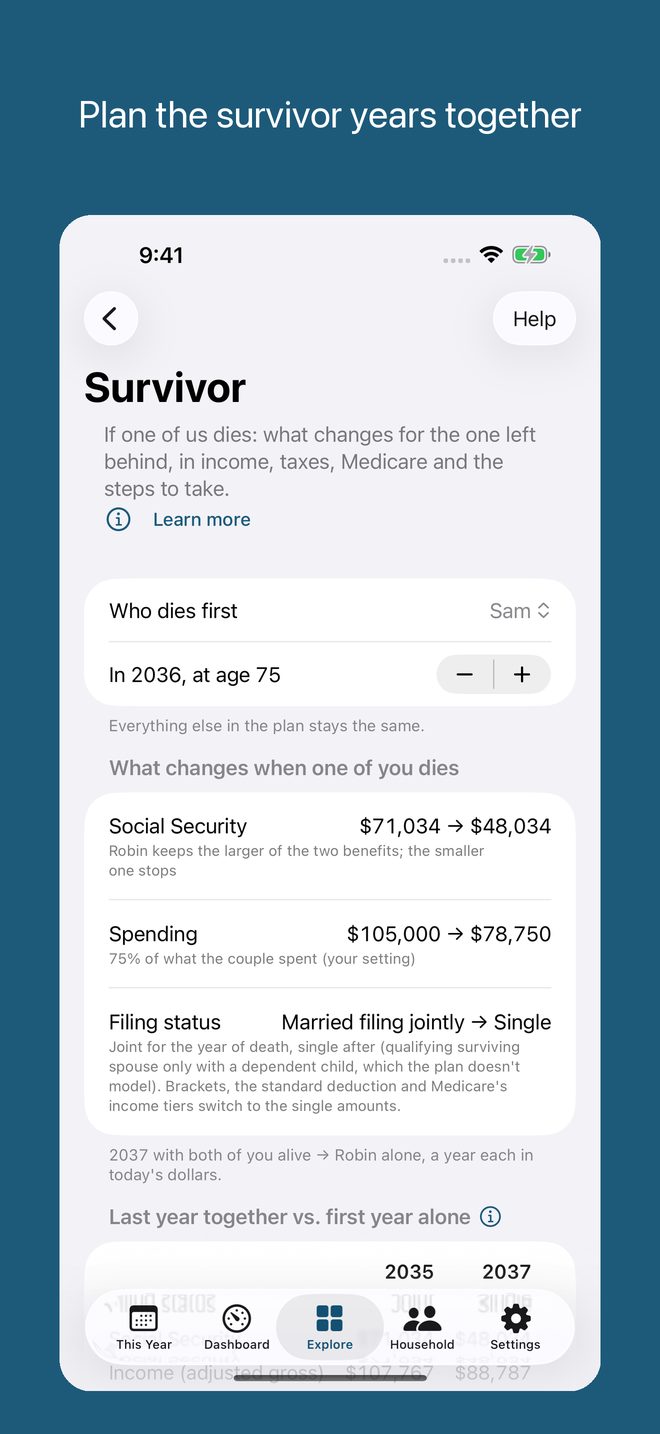
- The survivor years in every plan. Choose who dies first and when, and see the change in income, filing status, taxes and Medicare premiums.
- Last year together next to the first year alone, line by line.
- Roth conversion scenarios that count the survivor years, and a check of how each scenario holds up if one of you dies early.
- An "If I die first" guide for each of you to print and keep: what changes, and the steps to take.
References
The rules and figures on this page come from these official sources; the household in the example is made up. The app's calculations are also checked against them; see How we check our numbers.
Laws
- Public Law 119-21 (the One Big Beautiful Bill Act), as enacted (congress.gov)Used for: the senior deduction and its phase-out
- 26 U.S.C. § 1: Tax imposed (rates and the capital gains bands) (uscode.house.gov)Used for: the brackets for joint and single filers
- 26 U.S.C. § 63: Taxable income defined (standard deduction) (uscode.house.gov)Used for: the standard deduction and the extra amount from age 65
- 26 U.S.C. § 86: Social Security and tier 1 railroad retirement benefits (uscode.house.gov)Used for: the Social Security thresholds for joint and single filers
- 26 U.S.C. § 1411: Net investment income tax (uscode.house.gov)Used for: the investment income tax thresholds
- 42 U.S.C. § 1395r: Medicare Part B premiums, including the income-related amounts (uscode.house.gov)Used for: the Medicare surcharge lines for joint and single filers
Regulations and official guidance
- IRS Revenue Procedure 2025-32: 2026 inflation adjustments (irs.gov)Used for: the 2026 brackets, standard deduction and age-65 amounts
- Check your eligibility for the new enhanced deduction for seniors (irs.gov)Used for: the senior deduction's income limits for joint and single filers
- 20 CFR 418.1205: What is a major life-changing event? (ecfr.gov)Used for: the death of a spouse as a reason to ask for a lower Medicare surcharge
- Survivors benefits (ssa.gov)Used for: what a surviving spouse receives from Social SecuritySocial Security's site refuses automated link checks; this address was confirmed in a browser.
Forms, instructions and publications
- IRS Publication 501 (2025): Dependents, Standard Deduction, and Filing Information (irs.gov)Used for: filing jointly in the year of a spouse's death, and filing status after it
- IRS Publication 559 (2025): Survivors, Executors, and Administrators (irs.gov)Used for: the survivor's tax returns after a death
- IRS Publication 915 (2025): Social Security and Equivalent Railroad Retirement Benefits (irs.gov)Used for: the worksheet for the taxable part of Social Security in the example
- IRS Publication 590-B (2025): Distributions from Individual Retirement Arrangements (irs.gov)Used for: a surviving spouse treating an inherited IRA as their own
Agency data
- 2026 Medicare Parts A & B Premiums and Deductibles; 2026 Part D income-related amounts (cms.gov)Used for: the 2026 Medicare surcharge tiers
See it with your own numbers. Taxtirement works out every year of retirement for your household, federal and state, and puts the scenarios side by side so you can compare them. Coming November 2026 for iPhone, iPad and Mac.
More retirement tax questions
- Should we convert to a Roth, and how much?
- When should each of us start Social Security?
- Will Medicare surcharges (IRMAA) hit us?
- Before Medicare, how do we keep Marketplace (ACA) help?
- Should we give to charity from the IRA (QCDs)?
This page explains the 2026 rules as Taxtirement applies them, for education and planning. The example is a simplified household (federal income tax only, unless it says otherwise); your own figures will differ. It isn't investment, tax or legal advice. Rules change; check the official instructions, or a tax professional, before acting. Spotted something wrong? Tell us.