 Taxtirement
Retirement tax questions · 2026 figures
Should we convert to a Roth, and how much?
You've probably heard that Roth conversions can lower taxes in retirement. Whether one pays off for your household depends on things that are hard to see from the outside: your tax rate now and later, Medicare premiums, how much of your Social Security is taxed, and who inherits. Here's what goes into the decision, and how to compare the choices.
In short
- A conversion moves money from a traditional IRA or 401(k) to a Roth. You pay income tax on it now; after that it grows and comes out tax-free.
- It tends to come out ahead when the tax on the conversion is lower than the tax the same money would face later: in required withdrawals, in the years after one spouse dies, or for your heirs.
- The cost isn't just your bracket. A conversion can raise Medicare premiums two years later, make more Social Security taxable and shrink the senior deduction.
- A conversion can't be undone, so it helps to see how it holds up if the future turns out differently.
Why it's hard to know
The trade sounds simple: pay tax now at today's rate, or later at tomorrow's. The hard part is that neither rate is one number.
Today's rate has hidden parts. On top of the bracket, extra income in 2026 can:
- shrink the senior deduction ($6,000 for each person 65 or older), which falls by 6% of income above $150,000 on a joint return;
- raise Medicare premiums two years later, in steps that start above $218,000 of income for a couple (see Medicare surcharges);
- make more of your Social Security taxable once your other income plus half your benefits passes $32,000 for a couple;
- before 65, cost all of your Marketplace health insurance help at once (see the ACA cliff).
Tomorrow's rate is a forecast. It depends on how large your required withdrawals grow, whether one of you lives many years alone and files as single (see the widow's penalty), what your heirs earn, what your investments do, and whether tax law changes.
What matters
- The gap years. Between retiring and starting Social Security and required withdrawals (at 75 for anyone born in 1960 or later), income is often low and the lower brackets sit partly empty. Conversions in those years fill them.
- The size of later required withdrawals. The larger the traditional IRA grows, the larger each required withdrawal, stacked on top of Social Security and any pension.
- The survivor years. A widow or widower files as single, with brackets about half as wide, often on most of the same income.
- Heirs. Most heirs other than a spouse must empty an inherited IRA within 10 years, often in their own highest-earning years. An heir in the 24% bracket keeps less of an inherited IRA; a Roth reaches them without income tax.
- Your state. Some states tax conversions in full, some exclude retirement income up to a limit, and a planned move can change the picture. See how your state taxes retirement income.
- Where the tax money comes from. Paying the tax from a bank or brokerage account leaves the whole converted amount growing in the Roth; paying it out of the conversion leaves less.
An example with 2026 figures
A married couple, both 66 and retired. They're waiting to start Social Security and live on a $60,000 pension plus savings, and most of their savings are in traditional IRAs.
| Pension | $60,000 |
|---|---|
| Deductions: standard, age 65 and the senior deduction for both | $47,500 |
| Taxable income | $12,500 |
| Federal income tax | $1,250 |
On a joint return the 12% bracket runs up to $100,800 of taxable income, so converting $88,300 this year fills it. Their federal tax would rise to $11,600: $10,350 for the conversion, an average of 11.7%. The next dollar would be taxed at 22%.
What the bracket alone doesn't show:
- With the conversion their income is $148,300. That's just under $150,000, where their senior deduction would start to shrink, and well under $218,000, the first Medicare surcharge line for the premiums they'll pay two years from now. A larger conversion would run into both.
- If their IRAs are worth $1,000,000 when required withdrawals start at 75, the first one is that balance divided by 24.6 (the IRS table factor): about $40,650, taxable on top of their Social Security and pension, and larger each year after.
Whether paying $10,350 now comes out ahead depends on the rate those dollars would face later, across decades: in their required withdrawals, in the survivor's single-filer years, and for their heirs. That's a year-by-year projection, which is the part Taxtirement does.
What Taxtirement shows
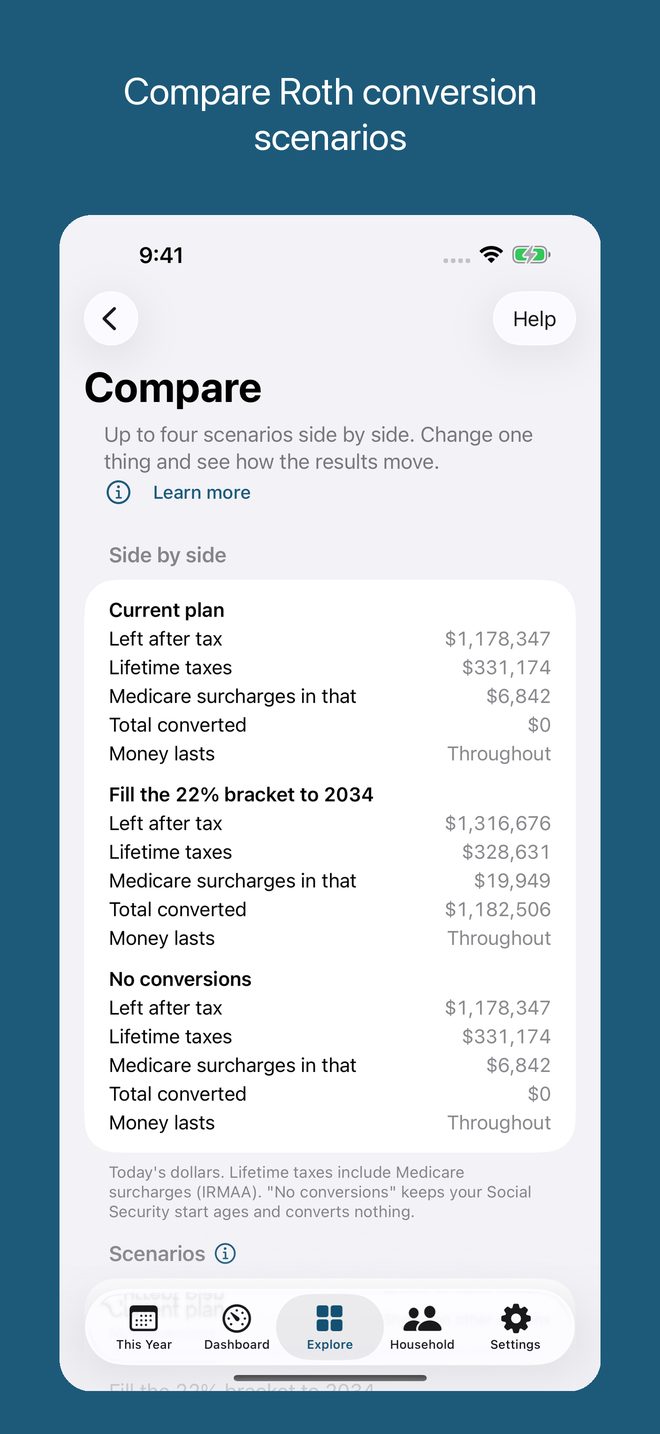
- Scenarios side by side. No conversions next to filling a bracket each year, staying under a Medicare surcharge tier, staying under the ACA cliff before 65, or amounts you choose. Each shows the estimated lifetime tax (including Medicare surcharges) and what's left after tax, in today's dollars.
- The highest-scoring scenario for your goal. Choose "leave the most after tax" or "pay the least tax over your lifetime". Taxtirement tries thousands of conversion amounts and Social Security start ages, scores each one, and shows the highest-scoring scenario next to making no conversions. It's a scenario to compare, not a recommendation.
- If the future is different. An early death, higher tax rates or poor markets: for each, whether the scenario still comes out ahead of making no conversions, and by how much.
- What you'd have after tax at 70, 75, 80, 85, 90 and the end of the plan, with the scenario next to making no changes.
- Your heirs, one by one. The 10-year rule worked out for each heir at their own tax rate, so "convert for the kids" gets a number.
- This year's room. How much more income fits before the next bracket, Medicare tier or ACA cliff, on a home-screen widget, with reminders in November and December.
- The calculation behind every number, with the IRS, SSA, CMS or state rule it comes from.
References
The rules and figures on this page come from these official sources; the household in the example is made up. The app's calculations are also checked against them; see How we check our numbers.
Laws
- Public Law 119-21 (the One Big Beautiful Bill Act), as enacted (congress.gov)Used for: the senior deduction and its phase-out
- 26 U.S.C. § 1: Tax imposed (rates and the capital gains bands) (uscode.house.gov)Used for: how the brackets work
- 26 U.S.C. § 408A: Roth IRAs (uscode.house.gov)Used for: what a conversion is and how Roth money comes out tax-free
- 26 U.S.C. § 401(a)(9): Required minimum distributions (uscode.house.gov)Used for: the age required withdrawals start, and the 10-year rule for most heirs
- 42 U.S.C. § 1395r: Medicare Part B premiums, including the income-related amounts (uscode.house.gov)Used for: how higher incomes raise the Part B premium (IRMAA)
Regulations and official guidance
- IRS Revenue Procedure 2025-32: 2026 inflation adjustments (irs.gov)Used for: the 2026 brackets, standard deduction and age-65 amounts in the example
- Check your eligibility for the new enhanced deduction for seniors (irs.gov)Used for: the senior deduction's amount and income limits
- 20 CFR 418.1135: Which year's income sets the Medicare income-related amount (ecfr.gov)Used for: the two-year lookback for Medicare surcharges
Forms, instructions and publications
- IRS Publication 590-A (2025): Contributions to Individual Retirement Arrangements (irs.gov)Used for: how Roth conversions are taxed and reported
- IRS Publication 590-B (2025): Distributions from Individual Retirement Arrangements (irs.gov)Used for: the Uniform Lifetime Table factor in the example, and inherited IRAs
- IRS Publication 915 (2025): Social Security and Equivalent Railroad Retirement Benefits (irs.gov)Used for: when Social Security becomes taxable
Agency data
- 2026 Medicare Parts A & B Premiums and Deductibles; 2026 Part D income-related amounts (cms.gov)Used for: the 2026 Medicare surcharge tiers
See it with your own numbers. Taxtirement works out every year of retirement for your household, federal and state, and puts the scenarios side by side so you can compare them. Coming November 2026 for iPhone, iPad and Mac.
More retirement tax questions
- When should each of us start Social Security?
- Will Medicare surcharges (IRMAA) hit us?
- What happens to our taxes when one of us dies?
- Before Medicare, how do we keep Marketplace (ACA) help?
- Should we give to charity from the IRA (QCDs)?
This page explains the 2026 rules as Taxtirement applies them, for education and planning. The example is a simplified household (federal income tax only, unless it says otherwise); your own figures will differ. It isn't investment, tax or legal advice. Rules change; check the official instructions, or a tax professional, before acting. Spotted something wrong? Tell us.