 Taxtirement
Retirement tax questions · 2026 figures
When should each of us start Social Security?
You can start Social Security any month from 62 to 70. Waiting pays more each month for life, but you collect for fewer years. For a couple the question is really two questions, because the larger benefit also becomes the survivor's benefit, and the start ages change your taxes for years.
In short
- With a full retirement age of 67, starting at 62 pays 70% of the full benefit for life; waiting to 70 pays 124%.
- Waiting comes out ahead if you live long enough: in the simple example below, past about age 80.
- For a couple, the larger of the two benefits continues to whichever spouse lives longer, so its start age affects both of you.
- Start ages change taxes too: how much of the benefit is taxed, how much you draw from IRAs, and the room for Roth conversions.
Why it's hard to know
The trade depends on things nobody knows for sure: how long each of you will live, what your savings will earn while you wait, and what tax law will be. And the choices interact. Starting one benefit early and the other late can work very differently from starting both at the same age.
Most "break-even" calculators look at one person and ignore taxes. For a married couple that misses two of the largest effects: the survivor benefit, and the taxes on everything else you draw while you wait.
What matters
- How much waiting adds. Starting before full retirement age reduces the benefit permanently. Each year after it, up to 70, adds 8% through delayed retirement credits. Every year's benefit also rises with the cost-of-living adjustment (2.8% for 2026).
- How long each of you might live. Your health and family history matter more than averages.
- The survivor benefit. When one spouse dies, the survivor keeps the larger of the two benefits and the smaller one stops. Delaying the larger benefit raises what the survivor gets, for as long as they live.
- The spousal benefit. A spouse can receive up to half of the other's full-retirement-age benefit if that's more than their own. It doesn't grow by waiting past full retirement age.
- Working while collecting. Before full retirement age, benefits are held back when earnings pass $24,480 (2026). They're not lost: the benefit is raised later to make up for them.
- Taxes on the benefit. Up to 85% of benefits become taxable once your other income plus half your benefits passes $32,000 for a couple ($25,000 single). Living on IRA withdrawals while you wait shrinks the IRA, and with it later required withdrawals.
An example with 2026 figures
Someone born in 1960 or later has a full retirement age of 67. Suppose their benefit at 67 is $2,000 a month, in today's dollars:
| Start at | Share of the full benefit | Monthly benefit |
|---|---|---|
| 62 | 70% | $1,400 |
| 67 | full | $2,000 |
| 70 | 124% | $2,480 |
Starting at 70 pays 77% more each month than starting at 62. Counting only the checks, before taxes and investment returns, the later start catches up at about age 80; after that, it's ahead for every month they live.
Now make them the higher earner in a couple whose spouse gets $1,300 a month. Whoever lives longer keeps the larger benefit. If it was started at 70, a survivor who has reached full retirement age keeps $2,480 a month for life; if it was started at 62, the survivor's benefit is permanently lower too. So the start age of the larger benefit matters for as long as either of them lives, which is often longer than either one alone.
Taxes move the break-even point. Waiting usually means drawing more from IRAs in your 60s, which leaves smaller required withdrawals later and can leave room for Roth conversions; starting early can mean more of the benefit is taxed sooner. Those effects depend on your own income, which is what the app works out.
What Taxtirement shows
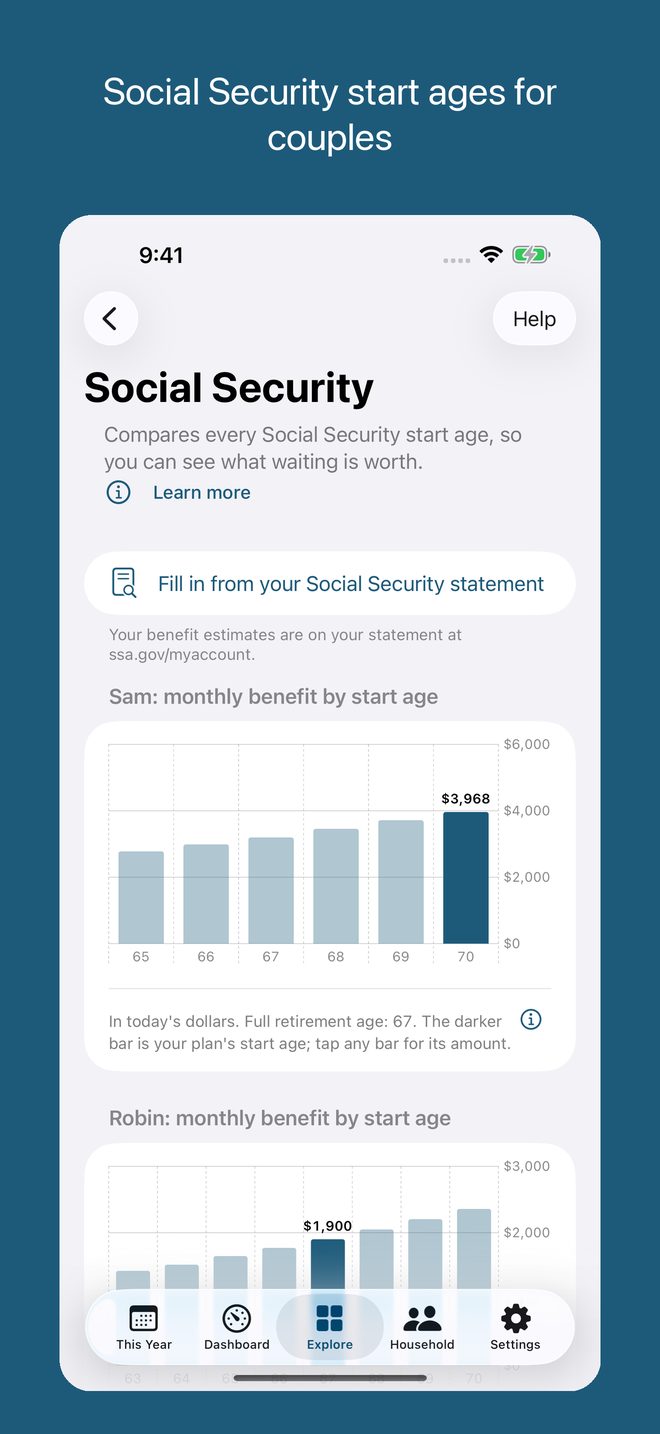
- Every pair of start ages. A grid of start ages for both of you, each square scored by what's left after tax, on average over how long each of you might live. Tap any square for its numbers; nothing changes in your plan until you choose to use those ages.
- Spousal and survivor benefits worked out from both records, including what the survivor keeps.
- The taxes around each choice: how much of the benefit is taxed, the IRA withdrawals it replaces and Medicare premiums, every year of the plan.
- Start ages and conversions together. The Roth conversion scenarios can try Social Security start ages at the same time.
- Your own benefit figures. Fill them in from your Social Security statement, read on your device.
References
The rules and figures on this page come from these official sources; the household in the example is made up. The app's calculations are also checked against them; see How we check our numbers.
Laws
- 42 U.S.C. § 402: Old-age and survivors insurance benefit payments (uscode.house.gov)Used for: the reduction for starting early, delayed retirement credits, and spousal and survivor benefits
- 42 U.S.C. § 416: Additional definitions (full retirement age) (uscode.house.gov)Used for: full retirement age of 67 for anyone born in 1960 or later
- 26 U.S.C. § 86: Social Security and tier 1 railroad retirement benefits (uscode.house.gov)Used for: how much Social Security is taxable
Regulations and official guidance
- 20 CFR 404.410: How SSA reduces benefits that start before full retirement age (ecfr.gov)Used for: the monthly reductions for starting early
- 20 CFR 404.313: Delayed retirement credits (ecfr.gov)Used for: the increase for each month of waiting past full retirement age, up to 70
- Retirement benefits: Delayed retirement credits (ssa.gov)Used for: how waiting past full retirement age raises the benefitSocial Security's site refuses automated link checks; this address was confirmed in a browser.
- Retirement benefits: Benefit reduction for early retirement (ssa.gov)Used for: how starting before full retirement age lowers the benefitSocial Security's site refuses automated link checks; this address was confirmed in a browser.
- Receiving benefits while working (ssa.gov)Used for: how the earnings test holds back benefits and raises them laterSocial Security's site refuses automated link checks; this address was confirmed in a browser.
Forms, instructions and publications
- IRS Publication 915 (2025): Social Security and Equivalent Railroad Retirement Benefits (irs.gov)Used for: the worksheet for the taxable part of Social Security
Agency data
- Cost-of-Living Increase and Other Determinations for 2026 (federalregister.gov)Used for: the 2.8% cost-of-living increase and the 2026 earnings test limit
See it with your own numbers. Taxtirement works out every year of retirement for your household, federal and state, and puts the scenarios side by side so you can compare them. Coming November 2026 for iPhone, iPad and Mac.
More retirement tax questions
- Should we convert to a Roth, and how much?
- Will Medicare surcharges (IRMAA) hit us?
- What happens to our taxes when one of us dies?
- Before Medicare, how do we keep Marketplace (ACA) help?
- Should we give to charity from the IRA (QCDs)?
This page explains the 2026 rules as Taxtirement applies them, for education and planning. The example is a simplified household (federal income tax only, unless it says otherwise); your own figures will differ. It isn't investment, tax or legal advice. Rules change; check the official instructions, or a tax professional, before acting. Spotted something wrong? Tell us.